Where Does Your Organization Really Stand? Understanding Transformation Maturity
How to Develop a Transformation Model Maturity for your Organization
Sabahat Naureen, MBA
1/7/20264 min read


"Who owns project delivery end-to-end in your organization?"
A few years ago, I was helping a crown corporation stand up their transformation office. The executive team wanted to hire a new transformation officer, had invested in cloud infrastructure, and hired data scientists.
But when I asked this simple question, there was no real answer. The COO pointed to the PMO director. The PMO director pointed to the CTO. CTO mentioned governance committees.
This was a crown corporation with decades of operational excellence and billions in annual capital projects. But no one in the room could articulate who was accountable for an outcome from start to finish.
"If a major project fails, who takes accountability?"
More silence.
They weren't ready for transformation because their organizational design was built for functional excellence, not integrated outcomes. They had world-class capabilities in silos, but no one owned the whole game.
This is no longer sustainable in 2026 or beyond.
Why Transformation Maturity Matters
According to McKinsey, 70% of transformations fail - not due to bad strategy or insufficient technology investment, but because organizations don't honestly assess where they're starting from.
This is the paradox I see repeatedly in energy, construction, and engineering firms: organizations with world-class operational capabilities that struggle to assess their readiness for transformation.
You can't build a roadmap if you don't know your starting point.
Most maturity models are academic exercises that mean nothing when you're managing a construction shutdown or dealing with field crews who've done things the same way for 20 years.
Capability vs. Maturity: The Critical Distinction
The Praxis Framework—the global standard for project, programme, and portfolio management—makes a distinction most organizations miss: capability is not the same as maturity.
Capability means you have the skills, knowledge, and tools in specific functions. You might have strong risk management or excellent stakeholder engagement.
Maturity means you've integrated those capabilities across your entire transformation lifecycle in a coordinated, systematic way. You're not just good at individual functions—you're orchestrating them together to deliver consistent outcomes.
Think of it like a sports team. Capability is having talented individual players. Maturity is those players working as a cohesive unit with practiced plays and clear roles.
A Level 2 organization trying to execute Level 4 initiatives isn't ambitious—it's setting itself up for failure.
The Four Dimensions of Transformation Maturity
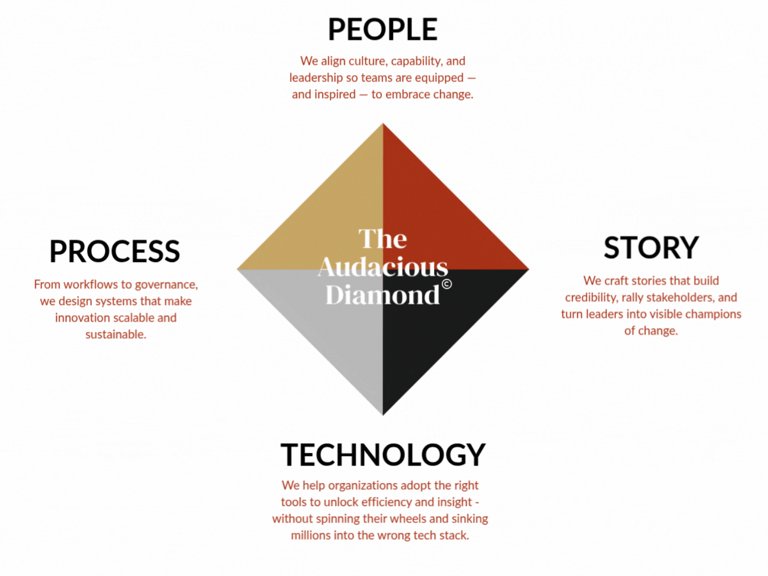
Real transformation maturity is about honest capability across four critical dimensions that must work together - what we call the Audacious Transformation Diamond:
1. PEOPLE: Culture, Capability, and Leadership
Level 1 - Resistant: Change is a threat. Middle management actively resists. New initiatives stall at implementation.
Level 2 - Reactive: Pockets of capability exist, but success depends on specific "change champions."
Level 3 - Capable: Systematic change management capabilities. Leadership aligned. Success rate improving.
Level 4 - Embedded: Change is DNA. Teams proactively identify improvements. Learning organization.
2. PROCESS: Design, Governance, and Scalability
Level 1 - Undocumented: Processes live in people's heads. Knowledge walks out the door.
Level 2 - Documented: Processes mapped but not standardized. Significant variation between teams.
Level 3 - Standardized: Clear standards followed consistently. Quality measurable.
Level 4 - Optimized: Continuous improvement based on data. Innovation is scalable.
3. TECHNOLOGY: Architecture, Integration, and Adoption
Level 1 - Fragmented: Disconnected systems. Every department has their own tools.
Level 2 - Functional: Core systems work but don't talk to each other. Manual data transfers.
Level 3 - Integrated: Systems connected. Data flows. Real-time visibility.
Level 4 - Intelligent: Technology enables new capabilities. Predictive analytics. Competitive advantage.
4. STORY: Communication, Credibility, and Movement
Level 1 - Unclear: No one can articulate why transformation matters. Confusion.
Level 2 - Leadership-Driven: Executives talk about change, but message doesn't land with frontline.
Level 3 - Stakeholder Aligned: Compelling narratives resonate across levels. Leaders are visible champions.
Level 4 - Movement: Transformation has momentum. People are advocates recruiting others.
The Crown Corporation Scenario
Through executive workshops, we assessed that crown corporation across all four dimensions.
Their self-perception: "We're probably at Level 3—we're sophisticated operators."
The reality: Solidly Level 2, pushing into Level 3 in some areas. They had developed some capabilities in isolation, but hadn't integrated them systematically. Strong individual players, but no cohesive playbook.
Within 18 months of addressing this honestly, they'd made measurable progress—not from hiring more consultants or buying more software, but from knowing where they were and what to build next.
Your Quick Self-Assessment
Be brutally honest:
People: Would middle managers champion change tomorrow, or quietly undermine it?
Process: Would three different teams handle the same workflow the same way?
Technology: Can you get accurate data when you need it, or wait weeks for outdated reports?
Story: Can frontline employees explain why transformation matters in their own words?
If you winced at more than half of these, you're probably overestimating your maturity by at least one level.
Understanding Your Constraint
Your maturity is limited by your weakest dimension. You can have Level 4 technology, but if your people are at Level 2, you won't get adoption. If one point of the Diamond is significantly behind, the whole structure collapses.
For that crown corporation, it was Story. Decent technology, improving processes, pockets of capability—but no momentum because communication wasn't integrated into execution.
What This Means for You
Organizations constantly try to implement Level 4 solutions at Level 2 maturity. They buy AI platforms before standardizing data. They launch enterprise tools before aligning leadership. They push digital adoption without building change capability.
Don't try to jump levels. Move deliberately:
Level 1: Develop basic capability—document processes, build foundational change skills, get core systems working.
Level 2: Focus on integration—consistent execution across teams, connect systems, enable two-way dialogue.
Level 3: Focus on optimization—embed continuous improvement, scale innovation, use data to decide.
Level 4: Focus on sustainability—maintain advantage, use transformation capability as strategic differentiator.
Once you know where you are, you can build deliberately. You don't need to transform everything at once. You need to strengthen the right capabilities and integrate them systematically.
The real question you should be asking is "Do we know exactly where we are and what we need to build next?
Ready to conduct a formal maturity assessment? In our next article, we'll walk through the step-by-step workshop process - including how to gather data, assemble the right team, score honestly, and build your roadmap.
Want to talk through where your organization stands? We've helped energy, construction, and engineering firms move from transformation chaos to deliberate capability building - because we've lived the operational reality you're dealing with.